


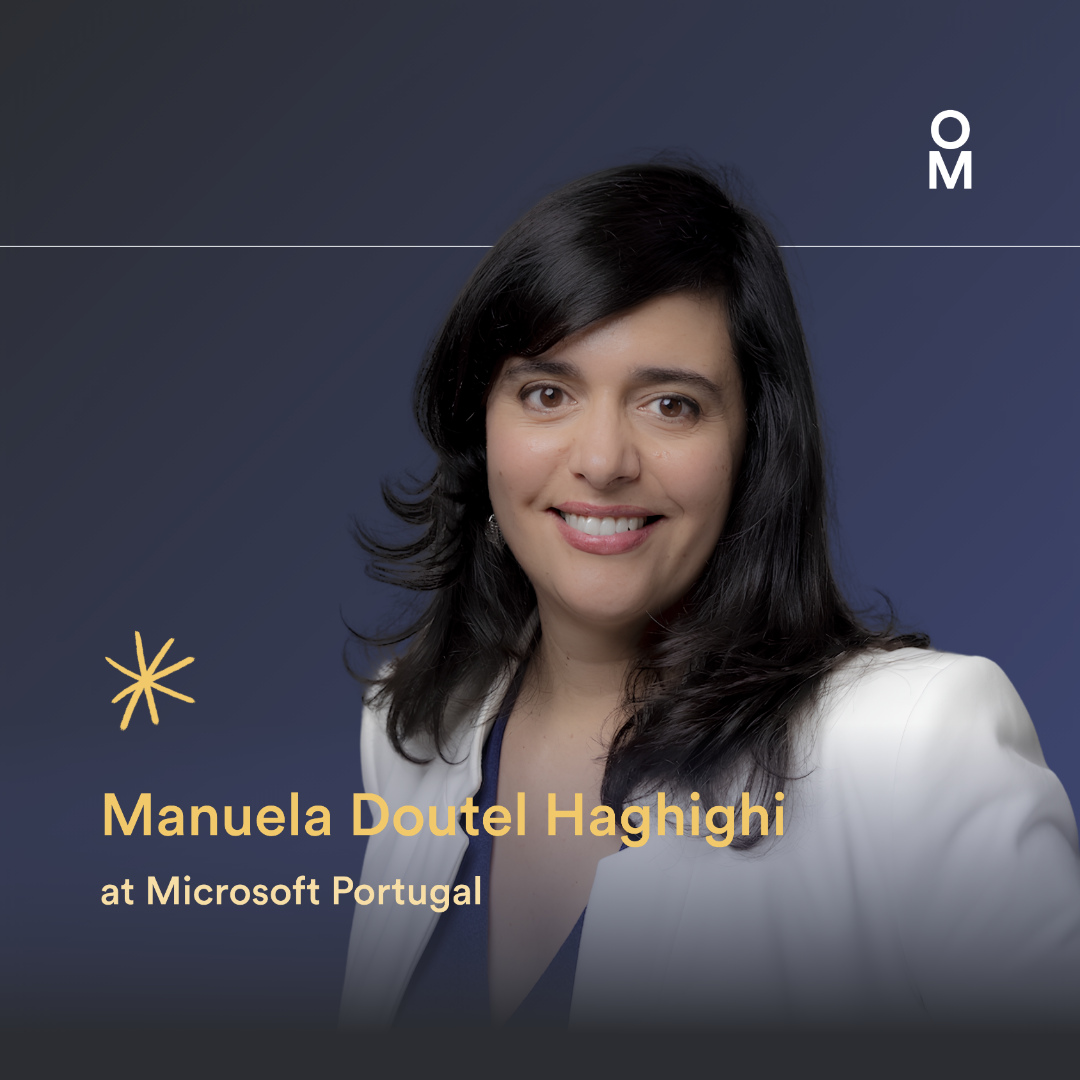
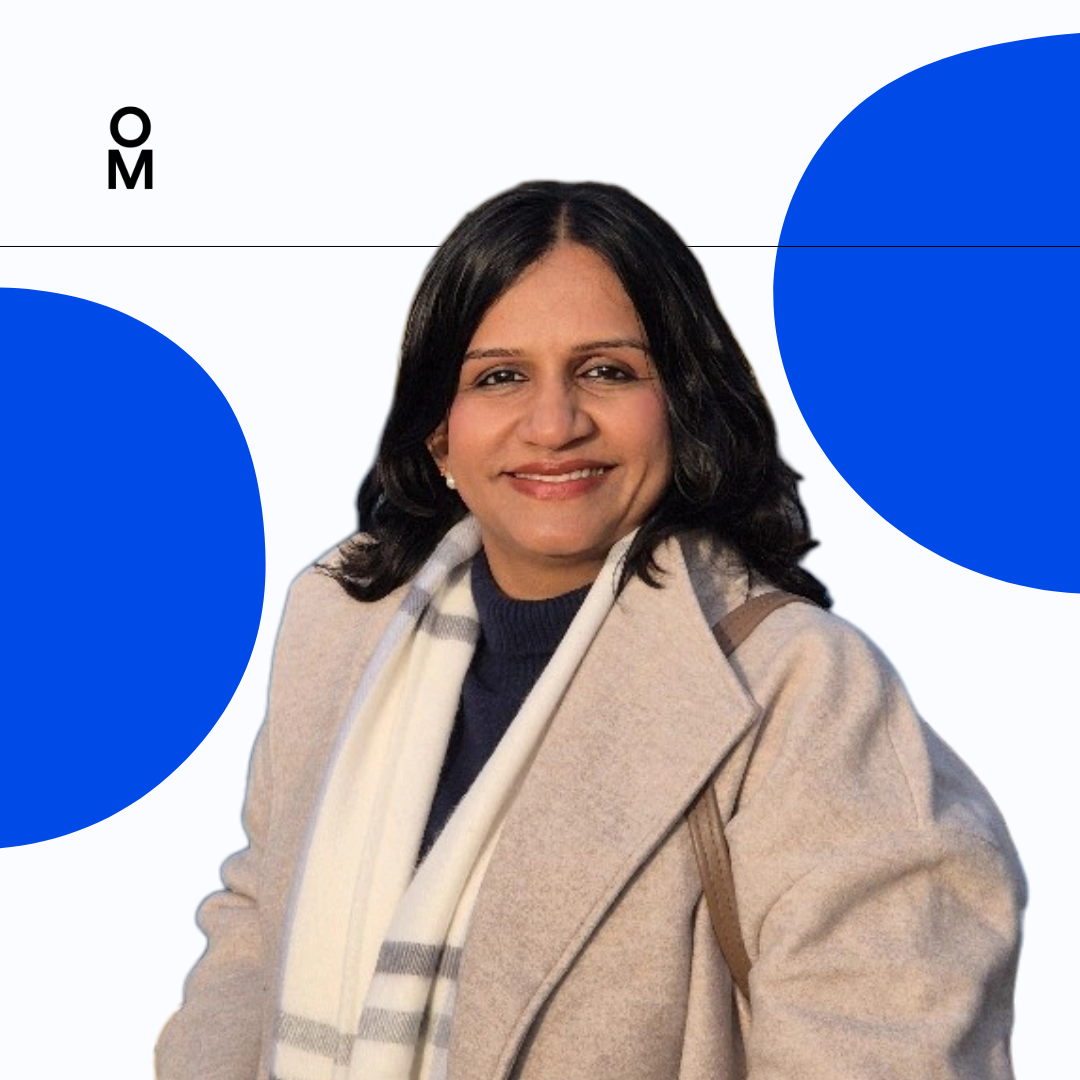
Manuela has that rare gift of making a lasting impression from the very first conversation. Not only because her energy and assertiveness fill any room she enters, but also due to her empathy and willingness to get involved in important causes, even if that means giving up much of her free time or comfort.
I met her when I was a bit disenchanted with large organisations and thought that real change could only happen on the outside, on the fringes. But Manuela showed me something else: that change can also happen from within, and that it is precisely in the most rigid structures that such courage is most needed.
This interview is, essentially, an attempt to understand where that enthusiasm she gave back to me comes from — for the word "career", for the world of work, for the idea that things really can be different.
Answer: My journey has never been a straight line, although it is not out of this world either. It has been shaped by curiosity, courage learned along the way, and a willingness to say yes, go and try, even when others advised against it. I was born in Toulouse, lived in Paris and Tehran, and came to Lisbon at seven; those early experiences were choices my parents made for me. At eighteen, however, while most of my friends stayed in Portugal, I chose, with my parents’ support, to return to France to study. I graduated in Business and Management from Toulouse Business School and later completed an MBA at Oklahoma University. Since then, I have chosen to live and work across seven countries and three continents, almost always in technology, a field I entered by coincidence rather than design. I spent seventeen years at IBM and three at Leidos, working across commercial roles, outsourcing, digital transformation and complex client situations, before joining Microsoft
Today, I lead global customer experience and client success work, bringing together technology, business transformation and the human relationships with customers that make change possible. Along the way, being a young foreign woman, and later a single mother, in a male-dominated industry taught me resilience, often the hard way. It also taught me the value of networks, mentors, sponsors and women who open doors for one another. If there is one thread through my career, it is this: until recently, I did not even have a five-year plan, but I kept moving towards work where I could learn, develop new skills, contribute and create impact.
Answer: I learned a long time ago not to romanticise large corporations. My education taught me to think critically about the world around me, and experience taught me to judge people and organisations by what they do, not by what they say, promise or put into slogans. Corporations can be slow, political and frustrating. I have seen that in difficult client situations, transformation programmes and moments when protecting a customer or a team required me to challenge the easier internal answer. But large organisations also make decisions at a scale that affects employees, customers, suppliers and entire ecosystems. If everyone who wants things to be different leaves, established structures are left to reproduce themselves, often through the same ways of thinking.
I, too, have wanted to leave many times throughout my career. Wise mentors and advisers helped me step back and recognise that staying could create a wider positive impact. It gave me the opportunity to demonstrate, in practical ways, that it is possible to deliver excellent service, look after people and, yes, still make a profit. It also allowed me to help build employee networks in South Africa, the UK and Portugal.
I stayed because I believe influence is not exercised only from the margins; it is also exercised in meeting rooms, budgets, processes, hiring decisions and the daily moments when someone challenges “the way we have always done it”. I have defended customers, colleagues and teams even when I knew there might be a personal cost, and I have seen people respond positively when excellence is delivered with empathy, honesty and respect. Change from within is rarely heroic. It is persistent, collective and sometimes painfully incremental. But when a large organisation shifts, even slightly, the reach can be enormous. For me, that possibility, turning individual acts of courage into change at scale, is what makes staying worth the effort.
Answer: This has been a long learning process. Especially as I am naturally outspoken and passionate. My mentors and coaches taught me to think before speaking or acting, often having to wait one or two days before answering an email, responding to a request or acting on a situation. Taking a stance requires taking risks, requires courage, requires acceptance that sometimes it will go really badly wrong, but always remembering that too shall pass. When we are in our 20s and even 30s, we often exaggerate the possible impact of what we say or do. With time, we realise that a year from now, that thing may not be that important anymore.
I have missed promotions, bonuses and probably a straight-to-the-top career path. Because along the way, I chose to defend customers, colleagues, teams. I would do it all over again, perhaps politically more wisely, but I would do it. Because nothing in history has progressed in the right way because people chose to do nothing or only thought about themselves.
These days, I ask myself three questions. Is the cause aligned with my values? Can my voice or position make a meaningful difference? And will silence cost more to others and to myself than speaking up? Not every battle has to be mine, and courage without judgment can become noise. But when an issue concerns dignity, fairness, inclusion or the ability of people to contribute fully, neutrality is often a choice in favour of the status quo, and I will act.
I have also learned not to act alone. Sustainable change needs allies, evidence, a clear objective and an understanding of the system you are trying to move. There can be a cost, and I no longer pretend otherwise. I try to prepare for that cost by seeking advice, building alliances and choosing the right moment, rather than confusing courage with acting alone. But my final test is very personal: I would find it far more costly to build a successful career that required me to become someone I could not respect, or someone my son and my nieces could not respect. Titles and bonuses are temporary; the example I set for them stays with me.
Answer: When I returned to Portugal, I arrived with a very clear memory of how important
women’s networks had been throughout my own career in the UK and South Africa. After learning from them, I had already co-created the IBM South Africa and Leidos UK ones. Coming to Portugal, with the first intent to meet new people, I found out the first group was being founded.
We analysed women's careers in the tech sector, whether in Portugal or the UK; the same pattern: the higher we progressed, the fewer women we saw around us, especially where money and power were involved like sales and leadership, and we knew that talent alone was not enough. People also need visibility, sponsorship, honest conversations and a sense that they are not navigating the system by themselves. Co-founding the first Women@Microsoft network in Portugal was a way of turning that experience into infrastructure for others.
What I learned is that a network cannot simply be a calendar of inspirational events. We designed ours to create connection, practical support, accountability and access to decision-makers, and to help women understand the unwritten rules that I had often had to learn the hard way. I also learned that women’s equality cannot remain “women’s work”. Lasting change requires leaders, managers and colleagues of every gender to examine the systems they influence, from recruitment and promotion to pay, representation and whose voice is heard.
That is why we eventually looked beyond Microsoft and began working with customers, partners and other influential actors in the market. This is not merely a women-in-technology problem. It is about more than half of society having too little influence over the products, services, financial choices and life decisions that directly affect them.
Answer: The idea of writing down what we want came to me through coaching techniques and The Artist’s Way, which encouraged me to write about everything: feelings, emotions, wishes and analysis. Like many people, I used to talk about what I wanted, but usually in vague, high-level terms that sounded like what everyone else wanted. A few years ago, I began a personal ritual, first at New Year and later on my birthday. I write honestly about the year that has passed and describe, as concretely as possible, what I want for every part of my life in the year ahead. I read the letter every night for seven nights, seal it in an envelope and keep it in my bedside table until the following year. When I open it, many of the things I wrote have happened, not because the letter is magical, but because writing them made them part of my subconscious and pushed me to work towards them.
etter was when my therapist asked me to describe my ideal partner. It would have been easy to write about a Prince Charming who does not exist, but experience had taught me to be specific about the person, relationship and values I wanted. I wrote the letter, beyond the kind, generous, intelligent person we all wish for, but describing a real human with a past, with clear opinions about politics, music taste and even spiritual preferences. Then created a practical plan to put myself in situations where I might meet such a person. Within ten days, we met, and we have now been together for almost six years. That experience reinforced something important for me: clarity only changes our lives when we turn it into action.
I returned to this exercise in 2021, at a moment when two parts of my life were pulling in opposite directions. I was completing a postgraduate degree in human rights, which I loved because it reconnected me with questions of dignity, fairness and impact. At the same time, I was deeply unhappy in the company where I worked. Its priorities had changed since I joined, and I could no longer see my values reflected in the direction it was taking. That contrast forced me to stop adapting to what was available and define, with much greater honesty, what I wanted next.
I realised that I had become very good at responding to opportunities that already existed but had never clearly articulated the opportunity I wanted to create. So, I described the role in concrete terms. It had to be international and client-facing, connected to transformation, and give me real responsibility and room to use both my commercial experience and my ability to lead through complexity. I wanted to work for a company whose values I could respect, continue creating impact through employee networks, move back to Portugal and still have an international remit and salary. The letter was not magical; it gave me a decision-making framework. Once I could name what I wanted, I could recognise it, talk about it and act on it. I rewrote my CV and LinkedIn profile to reflect that direction. Within three days, I received a call about an opportunity at Microsoft, and five months later I started. The letter changed me from someone waiting to be chosen into someone taking authorship of her next chapter.
Answer: Yes, absolutely. For a long time, I treated empathy and assertiveness as if choosing one meant betraying the other. Because I was naturally caring and wanted people to feel supported, I sometimes avoided difficult conversations or softened a message so much that it lost its meaning. At other times, especially under pressure, my directness arrived before my curiosity. Experience taught me that empathy is the effort to understand another person’s reality; it is not the suspension of standards, decisions or boundaries. Assertiveness without empathy can become fear-based leadership. Empathy without assertiveness can become avoidance. I need both.
Today, I try to hold both qualities together by being clear about the outcome while remaining curious about the person. I ask myself: What are they seeing that I am not? What pressure are they under? What do they need in order to move? In difficult customer situations, this has meant listening carefully to what is behind the complaint while still being honest about what we can deliver and what must change. With teams, it has meant making difficult decisions without treating people as obstacles to the result. Technology can make us faster and more efficient, but trust is built, or broken, in human moments. We cannot create trusted experiences for customers with employees who feel ignored, diminished or replaceable.
I used to be a people pleaser, and one of my coaches, Ronnie, once asked me, “What is more important to you, being liked or being respected?” It took me six months to change my answer internally from ‘liked’ to ‘respected’. That did not mean becoming colder or less caring. It meant accepting that a difficult but honest conversation can be more respectful than avoiding discomfort. I also learned that not everyone will like my style, whether I am being assertive or caring, and I have made peace with that. I do not like everyone either. What matters to me is mutual respect, especially with the people whose judgment I value. Because my directness can be strong when people first meet me, I now explain my intentions and working style early, instead of expecting them to interpret me correctly without context.
Answer: The repeating pattern is not a shortage of competent women. Across my career in Portugal, the UK and South Africa, I have repeatedly seen systems and expectations interpret the same behaviour differently depending on who displays it. In cultures where traditional gender models remain strong, those expectations influence what people recognise as performance, confidence and leadership. Women are often required to prove that they are ready before receiving an opportunity, while men are more readily promoted on potential. Women receive less sponsorship, carry more invisible work and are encouraged to be confident, yet may be penalised when that confidence becomes visible. This does not describe every woman or every man, but the research, and what I have observed throughout my own career, show that it remains a mainstream pattern.
I have also seen many women internalise the belief that they must meet every criterion before applying, asking for a promotion or speaking in a senior room. I recognise part of my younger self in that caution. But we must be careful not to turn this into another lesson about women fixing themselves. Confidence workshops may help individuals, but they will not repair biased promotion processes, unequal pay, homogeneous succession plans or cultures in which only one style of leadership is recognised.
My personal view is that we need to change the system itself by making organisations less top-down and more collaborative, even more cooperative. I would like to see large companies explore management and economic models in which every employee is also a shareholder, has a meaningful say in the direction of the company and can even vote for its leadership. That may sound ambitious, but I have seen a version of it work. When we designed the women’s network, we built it collaboratively rather than around one person’s authority. Members shared responsibility, contributed ideas and helped shape the direction together. That experience convinced me that people participate differently when they have genuine ownership, rather than simply being invited to support someone else’s agenda.
.png)
Answer: I understand the disenchantment. We were sold a fairytale in which one career ladder and one traditional family model were supposed to fit everyone and guarantee happiness. My own life taught me otherwise. I changed countries, moved across roles and sectors, became a single mother and made professional choices that did not follow a neat sequence. None of those experiences made my life less successful; they forced me to define success for myself. Education and access to information have helped many people see that the traditional model never guaranteed fulfilment. Too often, people remained in dysfunctional relationships, jobs or situations, hoping they would somehow improve on their own.
When it comes to work, I would replace the ladder with a landscape. A career is not one narrow route upward; it is a collection of experiences, relationships, risks and contributions that gradually expand what we are capable of doing. In my own career, progress has meant returning to France to study, moving across seven countries and three continents, working through commercial roles, outsourcing, digital transformation and complex client situations, and eventually choosing a role that brought me back to Portugal while retaining an international scope. Some moves were upward, others sideways, and several made sense only in retrospect. Sometimes progress is a promotion. Sometimes it is changing country, learning a new discipline, taking on a difficult client, pausing or choosing work that offers greater meaning rather than a more impressive title. I define a career as the evolving body of work through which we learn who we are, what we stand for and where we can be useful.
There is another reason the ladder metaphor fails: in the pyramidal structure of most organisations, not everyone can be promoted to the top. That promise is mathematically impossible. I have also seen, in my own career and in the lives of people around me, how much the traditional climb can demand in health, relationships and emotional wellbeing. Earlier in my career, I sometimes treated promotion as the clearest proof of progress. Today, I ask a different question: what am I being asked to sacrifice, and is the destination still worth that price? Younger generations seem increasingly willing to ask the same question. Dismantling the old dream does not mean abandoning ambition; it means defining ambition more honestly and refusing to measure an entire working life by proximity to the top of a pyramid.
I do want to make one important point: everyone should earn enough to live a comfortable and dignified life. I do not believe that meaningful financial security should be reserved for those at the top of the corporate ladder, while everyone else is expected to struggle. That is one of the reasons I believe in flatter, fairer organisations, where value, responsibility and prosperity are shared more broadly.
Answer: I wish someone had told me earlier that excellent work does not always speak for itself. School and university had taught me a very different model: if I followed the instructions, worked hard and produced a strong result, the teacher or professor would review it, and the quality would be recognised. I entered the workplace carrying that same expectation. For years, I assumed that if I delivered consistently, the right people would naturally notice. What I eventually learned is that professional environments do not work like classrooms. Leaders do not see everything we do, and performance is interpreted through visibility, relationships and context as well as results.
In the workplace, I learned that I was not expected to do everything perfectly. I was expected to make judgments, prioritise and explain the value of what I had delivered. That meant learning to speak about my contribution clearly and without apology and building relationships with people who understood my work well enough to speak for it when I was not in the room. This did not come naturally to me. At first, self-advocacy felt uncomfortably close to self-promotion. Over time, I understood that making my impact visible was not vanity; it was part of ensuring that my work could influence decisions and create further opportunities.
I would tell a woman at the start of her career to ask for the role before she feels completely ready, negotiate, keep evidence of her impact, find mentors who help her think and sponsors who are willing to use their credibility on her behalf. I would also tell her to learn about politics, human politics and office politics. Most people dislike the word, so I often begin by asking them to read its dictionary definition. I am not asking anyone to like politics; I am asking them to understand and master how decisions are made, how alliances are built and how influence operates. I learned too late that avoiding politics does not make us neutral; it simply leaves other people to shape the decisions that affect us. It is possible to navigate power honestly, ethically and without becoming someone we do not respect.
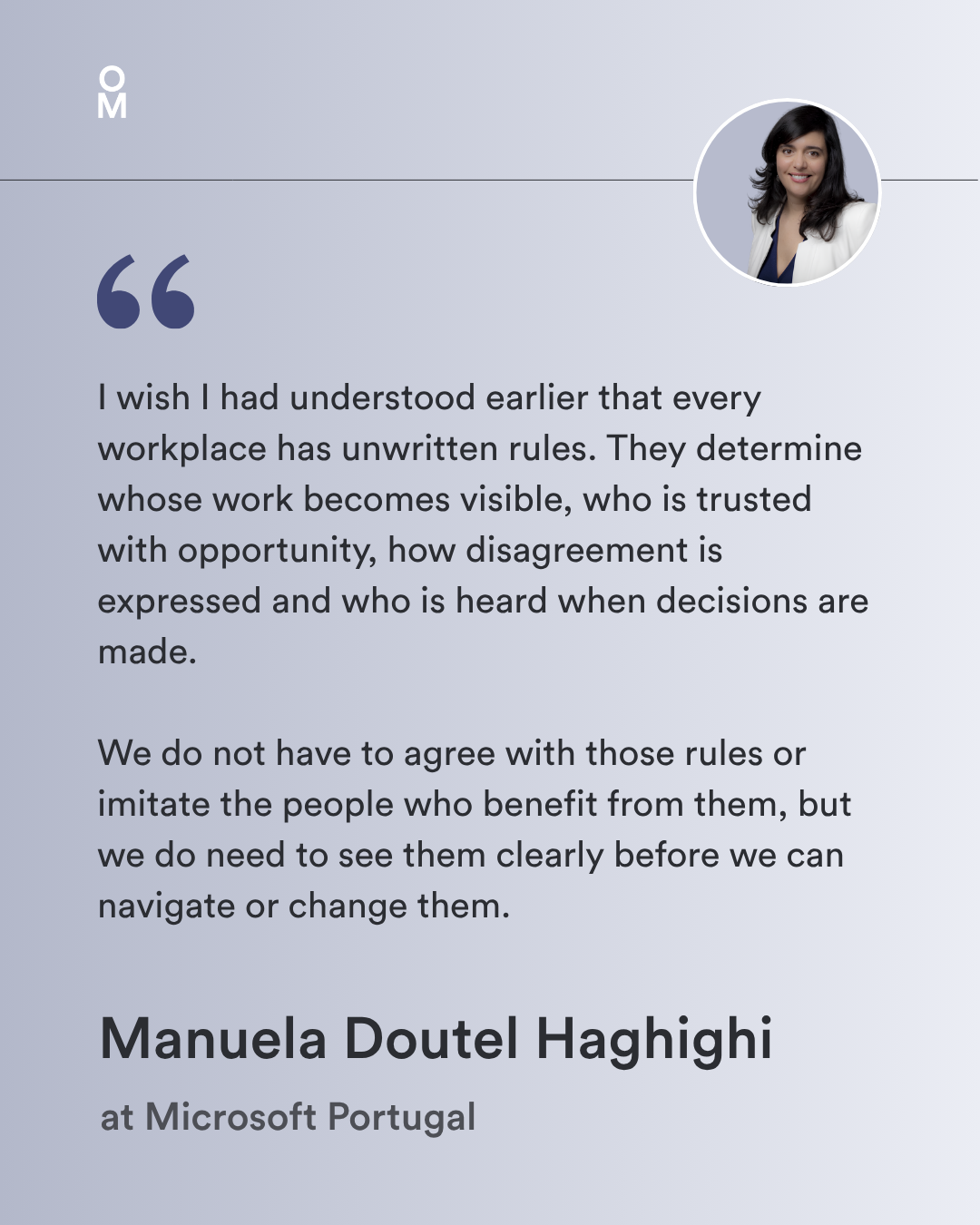
In a nutshell, I wish I had understood earlier that every workplace has unwritten rules. They determine whose work becomes visible, who is trusted with opportunity, how disagreement is expressed and who is heard when decisions are made. We do not have to agree with those rules or imitate the people who benefit from them, but we do need to see them clearly before we can navigate or change them.
Most importantly, I learned that I did not need to imitate the leadership style already at the top. The qualities that made me different, my directness, empathy, international experience and willingness to challenge established thinking, were not defects to manage. They were part of the perspective I could contribute. I would want a younger woman to understand that much earlier than I did.
Answer: I do not see myself as especially different or more courageous than the average person. Much of what I have done began with ordinary choices: speaking when remaining silent felt wrong, asking for help when I needed it and continuing even when I was afraid. I do not want other people to copy my choices. I want them, especially women, to look inward and ask what they would want to be or do if no one else had planted expectations in their hearts and minds. Then I want them to turn that answer into a plan.
I would also encourage them to surround themselves with people who help them move towards that life, and to create some distance, slowly but deliberately, from people who respond with constant negativity, fear or attempts to hold them back. I have learned that not everyone can support a change they do not yet understand. Their reaction may come from their own fears and struggles but understanding that does not require us to surrender our direction. We can remain compassionate without allowing someone else’s limitations to become our own.
I would add that change is not only about representation; it is about trust. We can change laws, processes and tools, but mindsets are harder to move. That is why every person, not only those with leadership titles, should ask: Who is present but does not feel safe to disagree? Who has access to opportunity? Who is trusted with meaningful responsibility? I have learned through employee networks, customer situations and difficult moments with teams that culture changes through the choices people make when no one is applauding them. Leadership, in the end, is not a title. It is the decision, repeated every day, to use whatever influence we have to leave the system fairer, more human and more trustworthy than we found it.






.png)


.png)


