


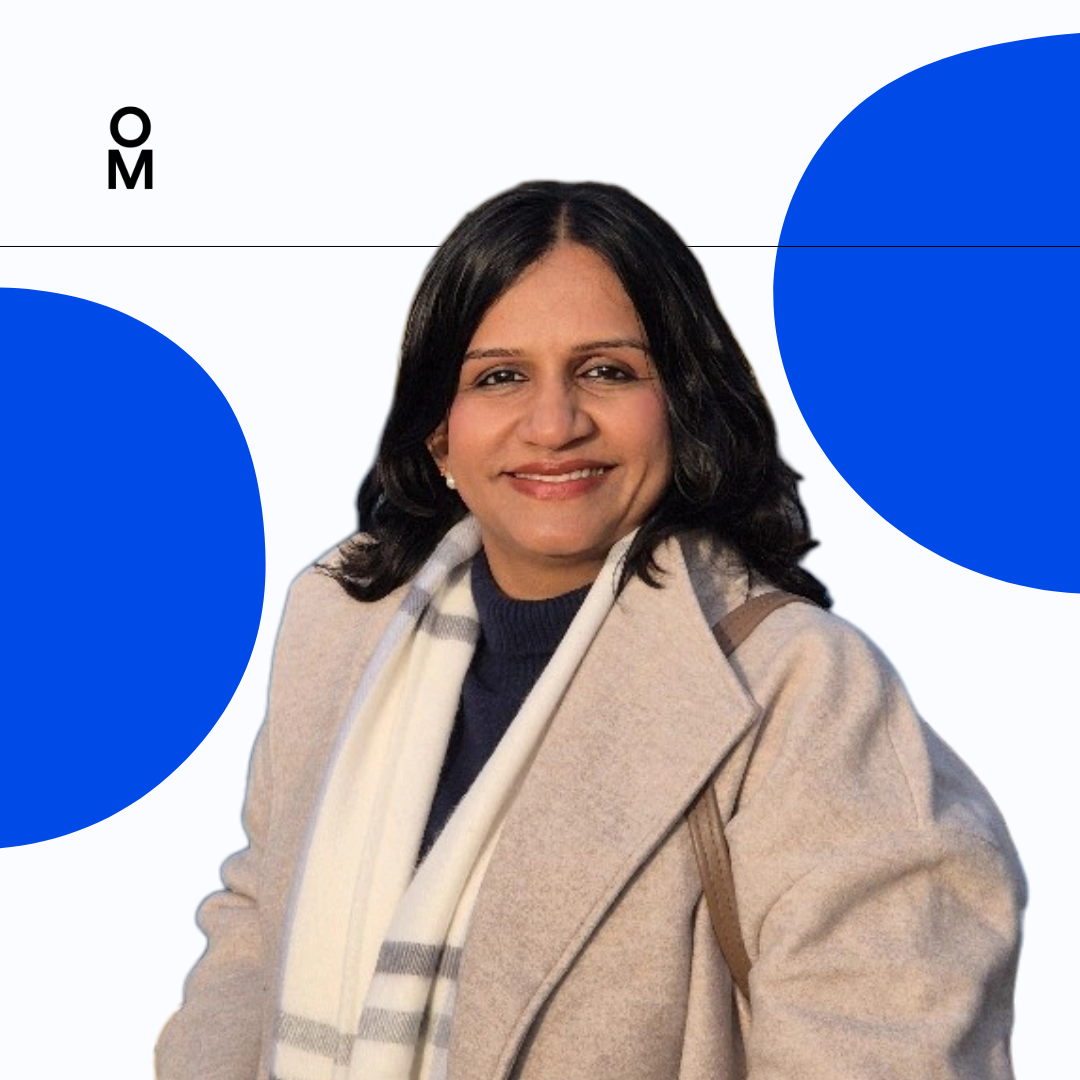
I work in digital and AI transformation for complex institutions, currently for a utilities company. We’re exploring how to improve their customer experience by incorporating AI into the company, making their lives easier, and their customers’ lives, who are getting a critical national infrastructure efficiently.
Two years ago, when I started working with them, we created a roadmap for infusing a five-year AI transformation for 5.5 million households in the UK. That project received the approval for 24 million pounds, and now, we’re putting that roadmap into place.
The great thing about it is that we're looking at the operational efficiency we can achieve. Usually, during storms, you have a storm overflow where discharges go back into waterways. With faster responses and better prioritisation of alarms, we’re hoping to reduce storm overflows by 33%, which is a huge percentage of reduction in pollution.
That's the kind of change that helped me move from working in charities, where I was handling 16 schools and affecting the lives of 6,000 children, to now transforming 5.5 million households.
That's predominantly the kind of work that I've been involved with over the last 13+ years. I aim to have that sustainable organisational change across sectors.
My path into tech was not linear, which is what makes it quite interesting. I started as a journalist and a research fellow studying digital access for marginalised
communities. That's how I went into change management, then I saw what a difference digital could bring, so I got into tech, which transitioned into AI in the past 5 years.
I work with charities and research organisations that have a mission of championing people who need extra support or know they have it in them, but don’t always have the resources. After I came to that space, I realised that the scale of change is limited, but also, how can we empower them further?
Digital was the thing to support education, so put those two together. I started working with a chain of schools called CMR, which had schools in India and Singapore. From the charity sector, I went into private education, looking at digital transformation across those schools.
It was great because the educators were of different age ranges, and change did not come easily, but we were preparing students for a future far ahead that we have not even seen. I learnt coding in school, but they were learning it much earlier than I ever did. I had to wait until 5th grade, whereas now students start as soon as 1st grade because they study computer science. It’s not technical coding in the strictest sense, but it’s about understanding the logic behind it, and seeing how a new language, in a sense, can be created.
From there, I moved from the public sector into the private sector. My background had been in development studies and journalism, so social development and anthropology were what I looked at: what made people tick? What would make them change their behaviours? That mindset was something I already had. What I felt I lacked was business acumen. That’s why I decided to do my MBA at Warwick Business School, which has been amazing in terms of its values: entrepreneurship, sustainability and diversity.
That’s when I moved more from programme delivery to shaping strategy. I was very keen to move into consulting on the digital side and to improve the kind of sustainable organisational change I wanted to bring about, so I pivoted into tech consulting.
One thing that set me apart was my anthropology background and focus on people and change. Translating between the social and the technical, and just getting things done, became my sweet spot. Being able to talk to people, understand their problems, and put their needs at the core of everything.
My clients started to expand across utilities, aerospace and defence, and financial services, so regulated, complex, and high-stakes industries. Getting technology or AI wrong in those sectors has real consequences. That human and change-focused aspect is often forgotten when software is built: if no one uses it, millions of pounds invested can go to waste.
For me, whether it’s a transformation programme for, say, a national security provider, it’s important that across 80,000 employees, DEI KPIs are built into the system, or that empathy by design is considered when building an AI-native enterprise.
Those values are very personal to me. Clients and teams appreciate it, even if it’s not top of their mind initially. When we do embed those KPIs, efficiency and savings improve because of the diverse perspectives that come in.
I'll give you an example. Last year, I won the Tech Women 100 Award. I don’t come from an engineering or STEM background – I love the sciences, but that’s not what I studied. My degree was in social sciences. Someone remarked, asked me, “You're not an engineer. How can you win an award in tech?”
He was joking, but it’s also a real question, one that someone trained in STEM, someone who’s very focused and head-down in coding, might ask. After all, no one usually nominates them because they’re neck-deep in their work. There’s a traditional perspective that you need to code and know data to work in tech, which is not the case.
I think if you watch any interview with the CEOs of Anthropic or OpenAI, they all say the same thing: it’s the people skills, empathy, negotiation, and decision-making that will set you apart going forward. Curiosity to learn and understand technology, and how it can solve real-world problems, is key. Don’t bog yourself down by thinking, “Oh, I don’t know how to code.” Today, most people have at least a basic understanding of code, and with tools like Claude or Lovable, you can even prompt code, so it’s not as much of a barrier anymore. Younger generations are learning coding in school, so they already have the basics from an early stage. Coding is no longer what will set you apart.
I was very fortunate to be a product manager of a generative AI product even before OpenAI and ChatGPT became mainstream. I was in strategy consulting and competitive intelligence, with M-Brain (now Valona Intelligence. I’ve also been able to see both sides of the coin: if you take the people aspect out of a tool, it creates very little engagement and impact. That’s something I still see every day.

My most valuable source of insights comes from having worked in companies of very different sizes. Working in charities and startups was particularly useful because it taught me to take on a range of responsibilities – you don’t get to do just one thing. You need to cover marketing, programme delivery, programme management, and finance.
Now in my career in consulting, the team management skill has helped a lot because your client can be of many sizes or different sectors, and that change is constant. Having worked across organisations ranging from three people to 87,000 and managing teams of all sizes is another valuable skill. A technique for introducing a change to a small department will differ a lot from a transformation that 10 departments might need.
Another key skill has been working with people at different seniorities. Early on, working closely with CEOs and founders taught me how much trust someone places in you. But in an 80,000-person organisation, it’s easy to feel lost. When you become a manager with a team of 30, you learn what responsibilities you can delegate and whom you can trust to deliver.
I also think about something I read once: when hiring, ask yourself, “Would I like to be managed by this person?” That’s the same lens I use when working with my teams. People don’t always see the best in themselves, so it’s about wishing for them things greater than themselves, mentoring them, and working alongside them to help them reach their full potential.
Doing an MBA exposed me to social structures where you work in teams, sometimes managing someone twice your age, from a very hierarchical background, with a different perspective on workspaces. That experience was valuable in understanding how women navigate the workplace and work alongside people with different experiences.
The last skill I’d highlight is curiosity. Technology, tools, and the world around us are constantly changing. You’ll never know everything, but you need to know enough to get started and be open to learning from others.
People like giving more work to those who get the work done, and this is usually women. I'm obviously generalising here, but research backs this up – studies consistently show that women take on significantly more "office housework," the unrecognised administrative and relational labour that keeps teams functioning. And the thing is: they're expected to. A woman who says no is seen as not being a team player by both men and women. A male colleague doing the same? He's just setting boundaries. At the same time, women are held to a higher standard, with more to prove, so they're likely doing far more work but getting far less time and opportunity to talk about it. That's the 1st reason – their visibility.
Now, imagine working for 13 years, and watching someone junior to you get promoted simply because he's a young male with less work on his plate and more time to advocate for himself. You could be earning at least 10% less than your male counterpart. The gender pay gap in the UK sits closer to 14% when you account for seniority, while you carry a disproportionate share of the actual workload. Meanwhile, he has a manager who isn't just mentoring him but actively sponsoring him. Women get advice. Men get advocates. That difference compounds over a career.
That's when I hear women saying, "Okay, I don't need the promotion, because when I get promoted, I'll just be given more work, but my pay will still be relatively low. There's no return on investment." Women are clear-eyed about this trade-off. They know what they bring, but the recognition and reward simply don't match it. This often leads to what's called a portfolio career – taking on contracts or exploring other avenues that feel more equitable and fulfilling, often alongside existing work commitments rather than instead of them.
The official reason women give for leaving is often that they're planning to have a child or already have two at home and can't maintain the balance. That may well be true. But what they often mean is that the return on investment simply isn't there, and that's the 2nd reason. Their contribution isn't recognised the way their colleagues' is, the growth opportunities aren't materialising, and at some point, the maths doesn't add up. They leave not because they're less ambitious, but because the workplace has already made that calculation for them.
This isn't just a culture problem. It's a systems problem. Managers have the power to change who gets visibility, who gets sponsored, and who gets stretch opportunities, but too often, those decisions are made on instinct and familiarity, and instinct tends to favour people who look like those already at the top. If women were incentivised, sponsored, and rewarded as equitably as men, they would stay. And in the UK alone, that could unlock an estimated £10 billion in economic value. But beyond the economic case, we'd be keeping some of the most capable, clear-eyed, and hardworking people in the room. Right now, we're pushing them out of it.
We need to do much more to support each other, as I don’t see that many opportunities within tech. Only after meeting Dr Vanessa Vallely and winning the Women in Tech 100 award, I’ve been introduced to a growing community of Women in Tech & AI.
For me, one person who shaped my career was Giles Walker, a former CTO at Microsoft. When I moved to the UK a few years ago, people kept telling me that I’m a foreigner and the job market would be very difficult for me, that I didn’t have a chance in any industry, especially in tech and data.
Giles accepted my LinkedIn connection request. We had a conversation I mentioned that I had moved to the UK and had been looking for a job. He told me his story of finding a role in 14 weeks. At that point, I marked 14 weeks in my calendar and started looking for jobs again.
By week 12, I had gotten through three interviews, and one of them was with one of the big tech firms. That same week, there was another company where I got through three interviews. In week 14, I started my new job. It all happened because I met Giles, and he told me his story, which really motivated me. So now to all my mentees I say, if you want a magic number, 14 weeks is your number.
If you’re someone who’s looking for growth, you might hit points where you feel low, even if you have the perfect career. Every day looks different for everyone, but you do need to pursue things that you believe in.
One piece of advice that has stayed with me comes from a book by Arundhati Roy, an Indian author, activist, Booker Prize winner, and someone who happens to be from my home state. She writes about this in her latest work, "Mother Mary Comes to Me." She describes being suggested as a ghost writer for her partner's film scripts. He would get credit for the work she had done, and she would get paid the same.
She didn’t accept it, even though, in that position, many would take it to stay employed. That struck me. It’s difficult to say no, especially when it comes to your self-worth and respect. But saying no and holding your ground is important. Don’t be afraid to fight for yourself, because if you don’t, don’t expect anyone else to. No one knows the full scope of your work as well as you do, so you need to be the person who speaks up for yourself.
Marcel Dévény, founder of Moonshot Negotiations, once told me that in negotiations, women who talk about themselves are often judged. Sometimes, you need a strategy: for example, frame it as advice from someone else, like Sheryl (like the author, Sheryl Sandberg, who wrote ''Lean In”). You can say, “Sheryl told me I should ask for this promotion.” It doesn’t even have to be a real person; it’s just a way to work around the system.
At the core, it’s about advocating for yourself. Deciding that you need to say something for your own sake can make a huge difference. No one can read your mind, so you need to say it, but it also helps you sleep better at night because you know you fought for the things you believe in.





.png)


.png)


