


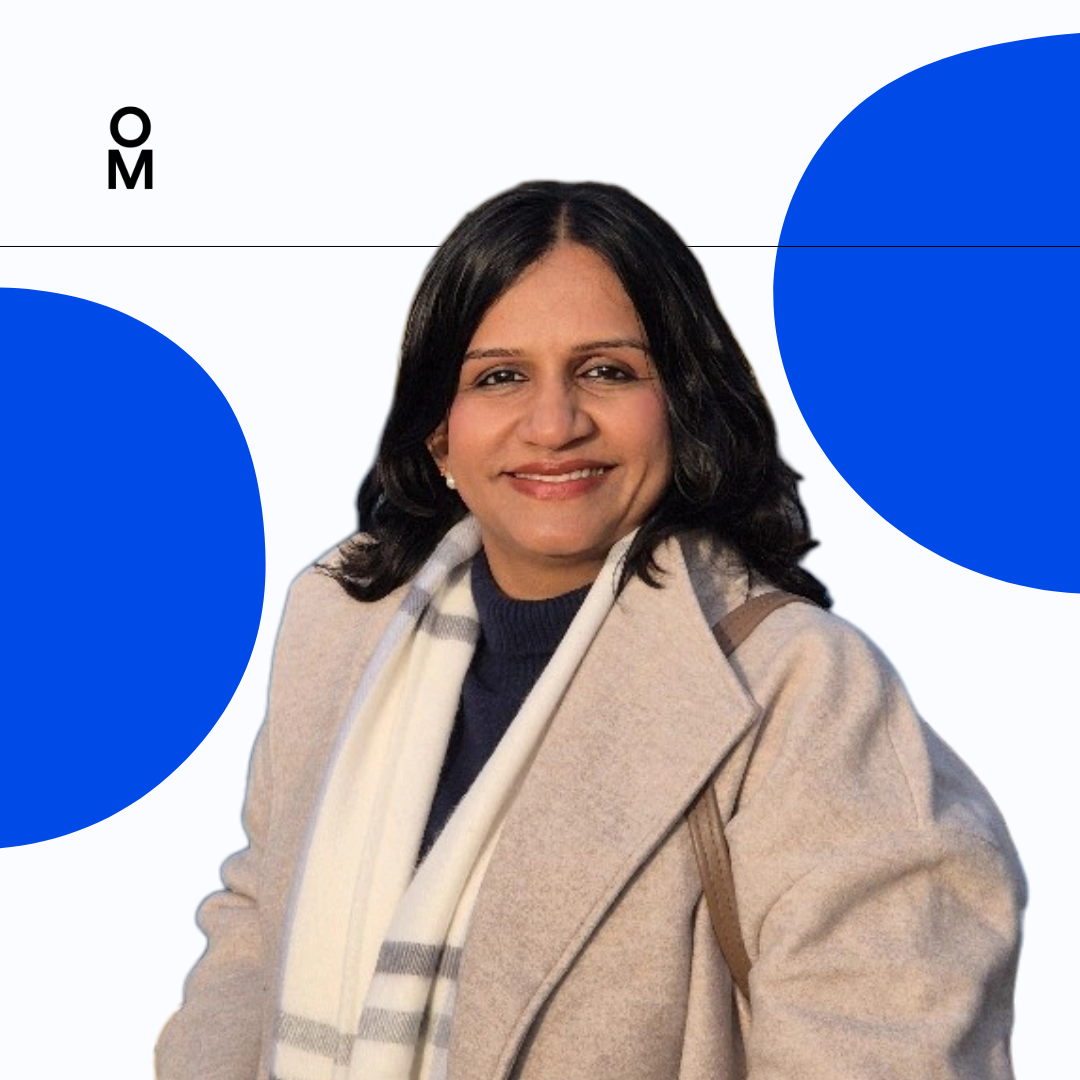
I've been in marketing, growth marketing, design, and web design for about 6 years. After that, I focused on a product as a product and UX/UI designer with operations and management experience. For the last four years, I have been working with AI, primarily with AI strategies, automations and agents around the product.
I work as an AI Systems Designer and Product Strategist. What I do is at the intersection of human behaviour and intelligent systems. I always ask myself this question: how do people understand, trust and collaborate with systems they don't fully control? I always vouch for trust between the product team, AI systems and their users.
Besides my work, I'm very into the community. I'm a co-leader for Ladies that UX in Lisbon, I collaborate with Women Techmakers, and am a IAmRemarkable facilitator. I do a lot of in-person speaking in Portugal, where I’m based, but also in the UK and Germany, and online for Asia, Canada, or the United States. I also work with Lovable and became their Ambassador. I'm the host of Human X Intelligent, a podcast and platform for the future of human-AI collaboration.
I was very shy when I was younger. To the point that when people would talk to me, I would feel nauseous. Sometimes, it was just very hard, but I did theatre and that helped me a lot. That's not exactly a professional example, but I often think about how it helped me become the person I am today professionally.
That helped me work towards a dream I had, which was international public speaking on big stages, which I have done. That’s been one of my biggest milestones.
I've experienced poor management throughout my career, but those experiences shaped the leader and collaborator I am today. Learning how to navigate difficult environments taught me resilience and helped define the standards I now bring to teams and products.
I guess one of the biggest challenges that I had was losing my grandfather while I was finishing my master's, working and doing a bootcamp at the same time. I finished it all for him, even though I didn't want to continue at that moment. For a long time, I just focused on my work, but once I looked at it from a different perspective, it helped me become better and stronger. I learnt how to separate the professional side from the personal.
I've met some of the most inspiring people through communities and networking. I am so proud that I'm part of Ladies that UX in Lisbon. It's one of the most fascinating communities I've ever been a part of. We actively support each other in public speaking, sharing feedback, practising together, and building confidence.
My community helped me understand how important women’s communities are. It’s great to see men allies joining us as well. Having a strong network can show you how many job opportunities are out there and how many people are willing to refer you.
I think when women work towards the same objective, they are so strong as a community.
The core idea I always come back to is this: trust must be designed from the beginning; the same way you’d design a flow or a state or an error message. You design the transparency, the controls, and the recovery when something goes sideways and the explanation for it. When you treat it that way, as a first-class material rather than something you add on at the end once the model finally works, that’s when people start to trust the system.
There’s always this temptation to show the user every step, signal, every piece of reasoning, and you end up overwhelming them as completely as if you’d shown them nothing at all. The magic comes when choosing what to show and when.
Feedback loops are the real infrastructure of trust. People learn to trust a system over time, the way you learn to trust a colleague, through small, consistent moments where it does what you expect. Good feedback design is what makes that learning possible.
Underneath all of it, there’s one question most teams walk right past, and it’s the difference between what the system can decide and what it should decide. That gap, between capability and authority, is where I think the whole game is played. I have a simple frame I use for it: at any given decision point, the system can automate, suggest, ask or defer. Four options. The teams that sit with that question early, who decide how much authority the system has earned at each moment, those are the ones whose users are still there in week three, week four, still trusting it.

I’m proud of a launch readiness review tool that I built. The idea is, the moment a team moves an initiative to ‘ready’ in the tracker, the workflow goes and pulls everything on its own, the brief, the tickets, the dependencies, all through the API and sends it to an LLM with a really tightly scoped prompt. What comes back is a structured summary, the metrics, GTM is aligned two weeks out, the rollback is documented, and crucially, every single line links straight back to the evidence so you can check it yourself.
On a clear failure, it holds the transition and tells you exactly what’s missing. On a pass, it makes a recommendation. A human always makes the final call. That part is deliberate.
The first lesson is that context discipline is everything. When I moved a design team off manual handoffs and into an AI-assisted pipeline, Figma into Cursor with structured context flowing between them, the whole difference between something genuinely useful and a confident hallucination came down to one thing: scoping exactly what the model could see. Feed it real inputs, and it answers from them. Give it room, and it fills the room itself. That’s the whole lesson, and it shows up everywhere once you start looking for it.
The second one is more personal. Early in my career, I shipped an AI feature framework far too fast. The user signal was strong, leadership wanted speed, so I moved ahead of the engineers who had to build it. Weeks later, they came back with objections, and we lost more than a month rebuilding. What that taught me is that speed of execution and speed of decision are two completely different things and people confuse them constantly. That’s exactly why this readiness workflow keeps a human in the loop on every pass and why I build these things with the teams who’ll use them, against their real launches, instead of arriving with something finished and asking them to live inside it.
A chatbot is like a GPS. It tells you where to turn, it gives you the information, but your hands stay on the wheel the entire time. You make every decision. If you ignore it, it just quietly recalculates and offers you the next suggestion. That’s its whole job!
An agent is more like a car that can touch the steering wheel. It assesses the situation and acts in a direction you only left implied in the moment. That one change, from informing to acting, changes the entire design problem underneath your feet.
With a chatbot, the work is conversation flows and clear language, because its role is to inform and respond. With an agent, the work becomes behaviours, policies, and safeguards, because now you’re defining what the system is allowed to do out in the world and how it keeps you in the loop while it does it. You move past writing dialogue into something much closer to writing the rules of conduct.
Here’s the test I always come back to, because it makes the stakes concrete. When a chatbot gives you a wrong answer, you’re annoyed, and you ask again. When an agent takes a wrong action, it books the wrong flight, it sends the email to the wrong person, it deletes the record. There are real consequences out in the world that you now must deal with.
For me, the product that has been designed for that second kind of moment, the consequential one, that’s the product that’s earned the word ‘agent’. Everything else is a chatbot wearing the label, and you can usually feel the difference within about 30 seconds of using it.
There is a lot of noise out there. You need to do this, you need to try this tool, etc. You most certainly do not!
In recruitment, the person on the other side is looking for someone curious, even if they are afraid of trying, they eventually will. Currently, if you know 6 to 10 tools, you're more prone to understanding how to use other tools more quickly. Besides that, there are a lot of things online right now that can help you learn every tool.
For those early in their careers, look at the job descriptions (that’s what I always do), see what the requirements are, and list what you know and what you don't know. From there, look at what you don't know, and choose just one thing to learn.
In an interview, tell the recruiter what tools you know how to use and explain how they relate to the tools they're asking for, even if you haven't used those exact ones before. Many tools are similar, and new ones can often be learned very quickly.
Regardless of where you are in your career. Try new tools, but don't overwhelm yourself. It's not worth it, and it won't help you. Use AI as a tool, not as a strategy. It shouldn't replace your thinking or your approach; it should be an addition to what you're already doing.
I have two pieces of advice.
1. There are only two options in life. One is to win, and the other is to learn how to win.
2. I think the main message I want people to take away is something I mentioned earlier: knowledge is one of the most valuable things we can have. It's not something that can easily be taken away from you, except, of course, in situations involving illness, and I think it's important to acknowledge that.
But in general, knowledge stays with us. More importantly, it's powerful because we get to decide what to do with it. No one else can make that decision for us. The more knowledge we have, the more informed choices we can make.






.png)


.png)


