


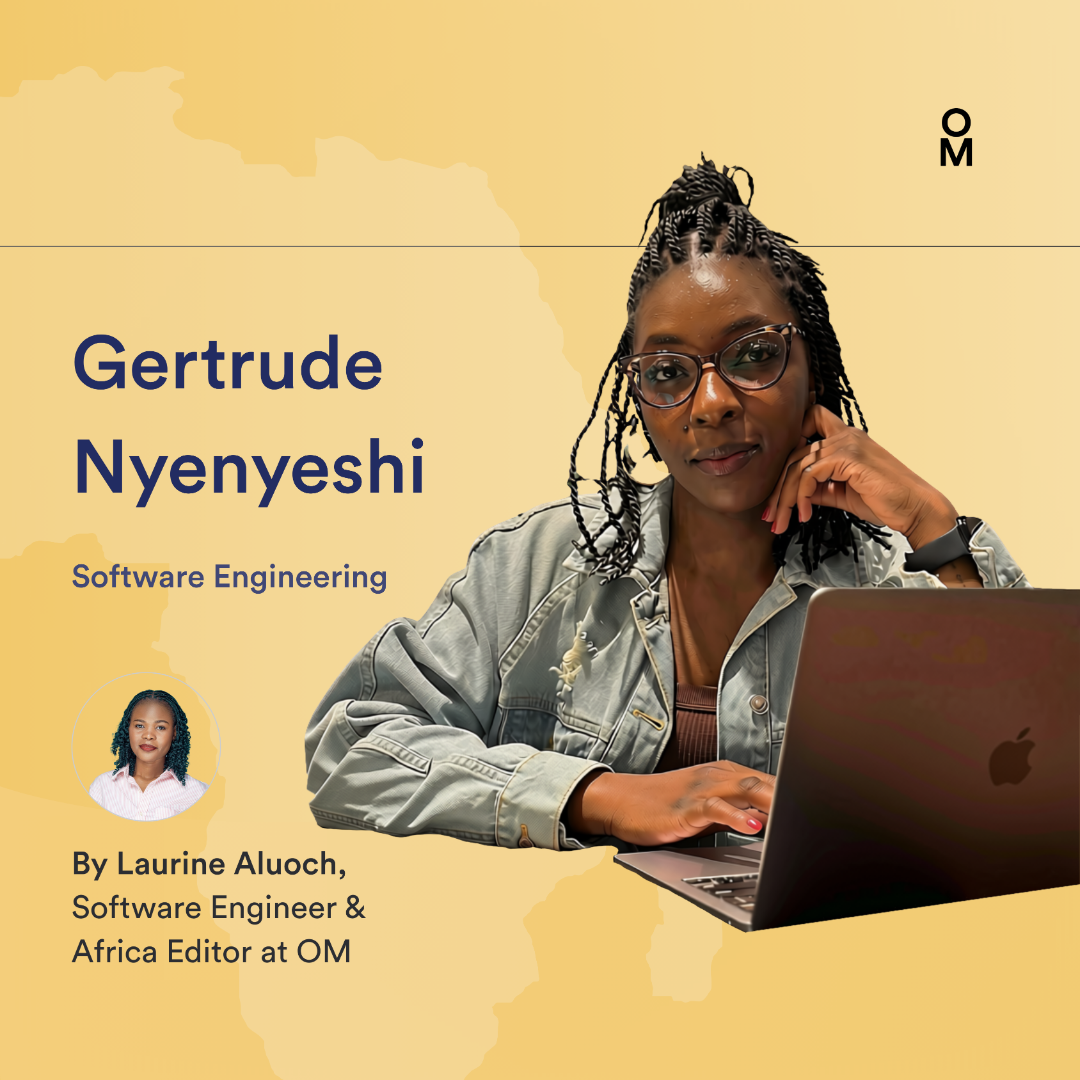
My journey into Tech wasn’t very clear at first. I was going to pursue tourism. I’ve always loved traveling, so I felt like tourism would give me that opportunity. However, from a young age I had been exposed to computers which piqued my interest. When I was around 12, my dad bought us a computer; one of those old desktops with a big monitor and a large back. My siblings and I used to play games on it quite a lot. My dad also bought us educational games. We would learn Mathematics and English, and later Physics and Biology. That exposure created a curiosity around technology for me. When I got to university and had to choose a course, Tourism still appealed to me, but Computer Science felt like it offered something more. I wanted something more exciting and challenging. So, I decided to take Computer Science and figure out how to travel the world later.
After university, my internships were mostly IT-related. I was fixing printers, setting up networks, and doing hardware work. Around then Software Engineering hadn’t really taken off in the way it has today. We had studied programming at university, but that was mostly in a classroom setting. I remember being worried about my career because I knew I enjoyed programming, but I wasn’t getting the opportunity to write software. Despite this minimal exposure, I kept on looking for software and website development jobs. I didn’t even have a proper laptop at the time, so I’d go to a cybercafé and check BrighterMonday for opportunities. One day, I saw an Andela opportunity and applied. At the time, Andela was still new, so there was some uncertainty around it. But I went through the process, joined the bootcamp, and that’s really where my career in software engineering began.
It was challenging at first because there was a lot I needed to learn and catch up on, but the community made a huge difference. We were recruited in groups, and people came from different backgrounds and levels of experience. Most of us were young and fresh out of university, so there was a lot of support. Andela also gave me my first real global exposure. I started working with global companies and realised that there were people around the world doing the kind of work I wanted to do. It really expanded my mind about what was possible for me and accelerated my career.
When I first started out, I was very focused on the code. I wanted to understand the programming language I used, how it worked, and how to complete the task I had been assigned. This is quite common at a junior level. You may only have access to the tickets and the immediate task without seeing the bigger picture of the product or project. As you grow, you start getting invited into these conversations. I began to understand the bigger picture, and my focus shifted from just the code to the problem I was solving. I began asking: What are we building? What problem are we solving? Is this solution what we need? Is it efficient?
I believe being able to extend myself beyond my code has been crucial to my growth. It is important that as you grow, you begin to understand the business and the users. For example, I worked on a project around asset management, and I knew nothing about the industry. I had to spend time understanding what an asset manager does, who their clients are and what problems they have. In a sense I extended my learning beyond the code I was writing. I believe that is one of the things that has helped me become a senior engineer. There’s also ownership. It is one thing to contribute to conversations, but as you become more senior, you need to be willing to challenge ideas and opinions and take ownership of parts of a project. You need to show initiative and become more vocal within your team. One last thing I have learned is that it is okay to say, I don’t know. When I was junior or mid-level, I thought being a senior meant knowing everything. But the more senior I became, the more I realised that you need to be comfortable saying, I don’t know how to solve this. That doesn't mean the conversation ends there. It means, I don’t know, so let’s figure it out.
One of the defining moments in my career was my time at the BBC.
The BBC is very big on accessibility; building the web for people with disabilities. Before I joined, my focus was more on technical depth: building features, developing solutions, and getting things done. The BBC taught me empathy. It made me think much more deeply about the people who were going to use the products we were building. I started asking questions like: Does this really benefit this type of user? Are we excluding another type of user? That changed the way I approached my work. I began thinking about the user from an empathetic point of view, and I cared much more deeply about what I was building. When you care about the people you are building for, you naturally want to become better at building for them. That pushed me to learn more about accessibility and eventually led me to take courses and build more expertise in the area. It also opened new opportunities for me. In roles after the BBC, I became responsible for accessibility strategy across entire organisations, rather than accessibility simply being something I considered as an engineer. So that experience really changed both how I thought about engineering and how I showed up in my career.
Technology has always been dynamic. When I joined the industry, React was coming up and there were all these frameworks emerging. Before that, people were using things like jQuery. So, I developed the mindset quite early that this would always be a field of continuous learning. Even with React, which I’ve worked with extensively, there have been major changes that required going back and learning again. With AI, the change is much bigger than simply learning a new library, but the underlying skill is still the same: you just have to adapt. We are using AI tools to review code, brainstorm and experiment. We are exploring things like agentic AI and MCP servers. At the same time, I don’t think anyone really knows what the next six months are going to look like. Things are moving incredibly fast. So, I’m comfortable saying, I don’t know. The important thing is to keep an open mind and experiment without trying to go too deep into everything at once. There are so many things happening that you can easily become confused or demotivated. Besides, we are in a period where nobody really knows exactly what the landscape will look like. We should strive to be comfortable with uncertainty even as we continue to upskill in these new domains.
Mentorship has really helped me develop my leadership skills. As a senior engineer, you are working with people at different levels, and mentoring helped me understand how to communicate with people differently. People are different. The way you explain a concept to one person isn’t necessarily how another person will understand it. It made me more curious about people and about how they think. I also realised that people value different things. I might care deeply about how users interact with a website or product, while someone else might be much more interested in how robust or technically complex the system is. Neither perspective is necessarily wrong. So, I stopped trying to apply one metric to everyone. Mentorship helped me think much more deeply about the human side of engineering. I want people to have a good experience in their careers, and I don’t want to be the person who makes someone feel demotivated simply because they don’t work or think exactly the way I do.
There are three things I’d say.
First, don’t take things too personally. That’s something I struggled with myself. Imposter syndrome can make you overanalyse people’s behaviour; what they say, what they don’t say, what they think about you and then give those things too much meaning. That can weigh you down and even delay your career growth because you stop pursuing certain opportunities based on something somebody said. Don’t give other people’s opinions too much power over your career.
Second, dream bigger than the dream. We all have career goals that feel achievable. For example, I want to become a Staff Frontend Engineer. I could focus on getting that title somewhere and be satisfied with that. But I also want to challenge myself to imagine that happening at one of the best technology companies in the world. So don’t just think about the dream that feels possible. Give yourself permission to imagine the one that feels almost impossible. Then ask yourself: What would I need to do to get there? What would that version of me look like? You might not achieve the exact goal, but you may end up somewhere between your original dream and the bigger one. And that stretches you much further.
Finally, stay curious. Tech isn’t dead because of AI. It’s changing. There will be new roles, new products, and new ways of working. We still need people to build products, manage systems, and figure out how to use these technologies effectively. The traditional paths may not be as clear as they were before, but there are still opportunities. I would encourage engineers to be more open-minded, experiment, and explore the different paths that are emerging. You don’t have to know exactly where technology is going. You just have to remain curious enough to find where you fit.







.png)


.png)


